
Installing Software On Mac Asks For Password
The password of your macOS user account is also known as your login password. It's the password that you use to log in to your Mac and make certain changes, such as installing software.
Change your password
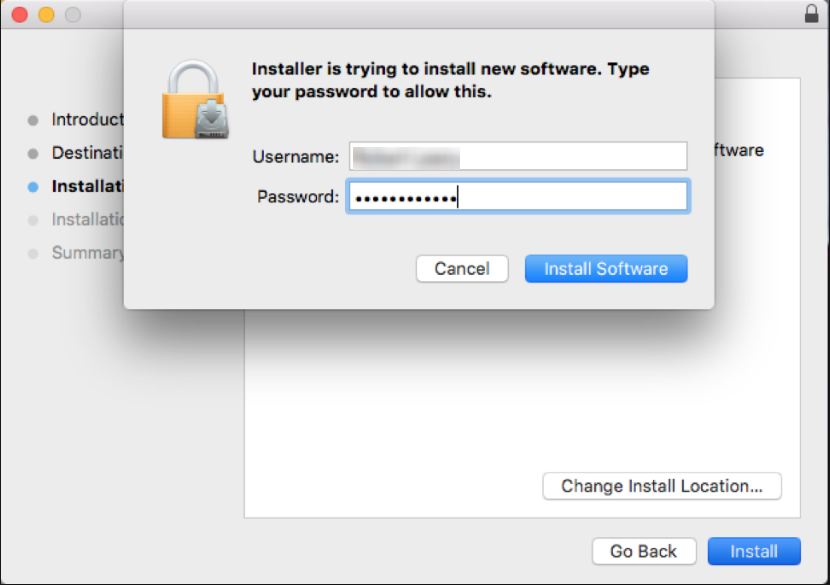
Installing reader on a mac; problem with password. When I try to install acrobat reader, I get a drop down menu with my name already filled in. When I enter my password, the box wiggles but does not go forward. Fluid app mac menu bar. I changed my password and that didn't work. I tried using my email address in the user box, but that didn't work. How can I make this work? Apr 14, 2016 This video will show you how to install any software without knowing admin password. If you want to run another program, just copy the name of.
If you know your password and can use it to log in to your account, you can change your password in Users & Groups preferences:
Double-click the 'dppm4.10.20-installer' inside the 'DPP4.10.20' drive. The Digital Photo Professional installation will start. Follow the on-screen instructions to complete the installation. After the installation is complete, the Digital Photo Professional installer may ask to restart the computer. In this case, restart the computer. For portable and wireless digital photography workflows, Canon's Digital Photo Professional Express (DPP Express) brings the powerful features of Canon's DPP software to your compatible iPad. Working with Canon's Camera Connect app., DPP Express streamlines the processing of JPEGs and.CR3 RAW files with an intuitive and powerful interface. Digital Photo Professional (DPP) is a high-performance RAW image processing, viewing and editing software for EOS digital cameras and PowerShot models with RAW capability. Using DPP you can easily perform basic and advanced editing and printing of RAW images. Canon dpp software mac download. To download an update for DPP (or install it from scratch) just click here for the Canon Europe Download Centre, then select your product type and camera model details and select the software option. The menu will offer a variety of downloads such as ImageBrowser EX, EOS Utility and EOS Digital Solution Disk Software, so scroll down and click.
- Choose System Preferences from the Apple menu, then click Users & Groups.
- Select your user name from the list of users.
- Click the Change Password button, then follow the onscreen instructions.
Reset your password
If you don't remember your password, or it isn't working, you might be able to reset it using one of the methods described below. But first try these simpler solutions:
In tiger, whenever iChat was launched, it asked for a username and password but now in leopard, when iChat is launched it automatically logs into my account. Multiple people use iChat on my computer and i just want to know if in leopard there is a setting to bring up that box that asks for sn and password like in tiger and panther. Jan 03, 2012 I am trying to install Mac OS X Lion The pop up asks for my password to allow install Mac OSX Lion to make - Answered by a verified Mac Support Specialist We use cookies to give you the best possible experience on our website. It will not ask for the password while installing mysql in Ubuntu 16.04 but you can set it after successful installation in following way. MySQL asks for root password but I was never asked to set one during installation. Mysql root password when install from Ubuntu Software Center. So, when you install software – when you initiate the installation, not when a web page downloads software and launches the Installer application – it is normal that you enter a password. When certain system functions ask for your password, this is normal too. However, make sure that these are real system functions. There are only a handful.
- Make sure that you're typing the correct uppercase or lowercase characters. If your keyboard has Caps Lock turned on, the password field shows a Caps Lock symbol .
- If the password field shows a question mark, click it to display a password hint that might help you to remember.
- Try to log in without a password. If that works, you can then add a password by following the steps to change your password.
- Try to log in with the Apple ID password that you use for iCloud. If you just changed that password and the new password isn't working, try the old password first. If that works, you should be able to use the new password from then on.
Jul 06, 2010 Next time your mac asks you if you want a password stored in your keychain, click 'yes', it will then not need to ask you again in an identical instance. If you are attempting to move files whose ownership resides with 'not the same person' in both moving from and moving to, the mac WILL ask you for password, to not breach the 'privacy' of the.
Reset using your Apple ID
In some macOS versions, you can use your Apple ID to reset your login password. At the login screen, keep entering a password until you see a message saying that you can reset your password using Apple ID. If you don't see the message after three attempts, your account isn't set up to allow resetting with Apple ID.
- Click next to the Apple ID message, then follow the onscreen instructions to enter your Apple ID and create a new password. You'll be asked to restart when done.
- Log in with your new password.
- Determine whether to create a new login keychain.
Reset using another admin account
If you know the name and password of an admin account on your Mac, you can use that account to reset the password.
- Log in with the name and password of the other admin account.
- Choose System Preferences from the Apple menu, then click Users & Groups.
- Click , then enter the admin name and password again.
- Select your user name from the list of users.
- Click the Reset Password button, then follow the onscreen instructions to create a new password:
- Choose Log Out from the Apple menu.
- Log in to your account using your new password.
- Determine whether to create a new login keychain.
Reset using the Reset Password assistant (FileVault must be on)
If FileVault is turned on, you might be able to reset your password using the Reset Password assistant:
- Wait up to a minute at the login screen, until you see a message saying that you can use the power button on your Mac to shut down and start up again in Recovery OS. If you don't see this message, FileVault isn't on.
- Press and hold the power button until your Mac turns off.
- Press the power button again to turn on your Mac.
- When the Reset Password window appears, follow the onscreen instructions to create a new password.
If you need to connect to Wi-Fi, move your pointer to the top of the screen and use the Wi-Fi menu to connect. To exit without resetting your password, choose Apple menu > Restart. - When done, click Restart.
- If you were able to reset your password with the Reset Password assistant, log in to your account using your new password.
- Determine whether to create a new login keychain.
Reset using your Recovery Key (FileVault must be on)
If FileVault is turned on and you have a FileVault Recovery Key, you can use that key to reset your password.
- At the login screen, keep entering a password until you see a message saying that you can reset your password using your Recovery Key. If you don't see the message after three attempts, FileVault isn't on.
- Click next to the message. The password field changes to a Recovery Key field.
- Enter your Recovery Key. Use uppercase characters, and include the hyphens.
- Follow the onscreen instructions to create a new password, then click Reset Password when done.
- Determine whether to create a new login keychain.
If you can't log in with your new password after restarting your Mac, take these additional steps:
- Restart again, then immediately hold down Command-R or one of the other macOS Recovery key combinations until you see the Apple logo or a spinning globe.
- When you see the macOS Utilities window, choose Utilities > Terminal from the menu bar.
- In the Terminal window, type
resetpassword, then press Return to open the Reset Password assistant pictured above. - Select ”My password doesn't work when logging in,” then click Next and follow the onscreen instructions for your user account.
Create a new login keychain, if necessary
Best Software For Passwords
After resetting your password and logging back in to your account, you might see an alert that the system was unable to unlock your login keychain. This is expected, because the passwords for your user account and login keychain no longer match. Just click the Create New Keychain button in the alert.
If you didn't see an alert about your login keychain, or you see other messages asking for your old password, reset your keychain manually:
- Open Keychain Access, which is in the Utilities folder of your Applications folder.
- Choose Preferences from the Keychain Access menu, then click the Reset My Default Keychain button in the preferences window. After you enter your new password, Keychain Access creates an empty login keychain with no password. Click OK to confirm.
If you don't see a Reset My Default keychain button, close the preferences window and select the “login” keychain from the left side of the Keychain Access window. Press the Delete key, then click Delete References. - Choose Log Out from the Apple menu to return to the login screen.
- Log in to your account using your new password. Your account password and login keychain password now match again.
If you still can't log in
Forgot Password For Mac Computer
If you still can't log in with your password, contact Apple Support for help.
I am running OS X 10.7.3. Whenever my Mac asks for my password, for example to install an app, it fails and does nothing. I’m entering the correct password and I’m using the admin account.
Reset Password On Mac
Open up System Preferences, go into Users & Groups and make sure that the account you are currently using is set to 'Allow user to administrate this computer'. You can also try changing your password there ~ maybe this helps.
Also as previously suggested you may want to run Repair Permissions within Disk Utility (Applications/Utilities).One general step to solve troubles would be to (re)install the latest combo update however if your Mac doesn't accept your password this is out of the question.
Last but not least you can follow this guide about removing the AppleSetupDone file.
When creating a new user set the same username and shortname as the existing user. This will trigger a question whether you want to use the existing home folder for this user. Once you click yes you should get back into your user account with all files and settings and administrative access.* Backup, backup, backup. The above only works in a 'perfect' world. You may lose all your user files and settings.
I'm getting this problem as well, I first noticed it when I tried to update Adobe Flash. The password is correct because if I type an incorrect password the box jiggles in the usual fashion to show its wrong, yet when I type in my correct password theres no movement, the box just disappears and I'm left with the original installer box asking if I want to install/cancel. I've just tried installing Firefox and it hasn't happened but maybe cos it asks you to drag the folder into the applications folder, rather than any installer steps. I've tried all the above to no avail..anyone else having this trouble? Its been going on maybe 3 months now.
Not sure at which point your installation fails ~ does anything happen if you click install again? Does it ask for the admin password again?
You could try installing things in Safe Mode.
If that works I suggest to manually download and install the latest Combo Updater for your Mac OS X version [again, in safe mode].
Before doing so you probably want to backup your user profile. If your system really is corrupt in such a strange matter things can go anywhere..
I have experienced 'corrupt but booting' systems going completely dark (dead) during the reboot although Combo Updater finished without errors.
If your password authentication failed, it would not 'do nothing'; it would tell you that your password was incorrect, at the very least. But if that same password has worked before, then something is wrong on your system.
You should first open Keychain Access and choose 'Keychain First Aid' from the Keychain Access menu, then try reinstalling that app with your admin password. If it still fails then your Admin password keychain may be corrupt.
Repair Permission and Repair Disk will not solve your problem, because they have nothing to do with it.
How do you know the password you are typing is correct? Are you able to login with the password you are using, or use it anywhere else and it work?
check that your privileges are set to your user name and not 'system'
Mac OS X: Software installations require administrator password
http://support.apple.com/kb/HT2558run Repair Disk Permissions, and Repair Disk
http://kb.sage.edu/kb/index.php?View=entry&EntryID=168