
Photo Focus Stacking Software Mac
Jul 04, 2020 Sequator is an easy-to-use and intuitive astrophotography software for stacking both starry landscape and deep-sky images. It can also be used to create star trails. While not as advanced as other stackers, it nonetheless allows you to calibrate your. Dec 18, 2012 I could never get the Mac apps to work correctly. I doubt you're going to get much from stacking a dozen images of Jupiter anyway. Usually those are done by stacking hundreds of frames from video and throwing the bad ones out. I know you're not a Windows person but that's kind of where the software lies today.
- Mac Photo Stacking Software
- Photo Focus Stacking Software Mac Review
- Photo Focus Stacking Software Mac Download
- Astro Photo Stacking Software Mac
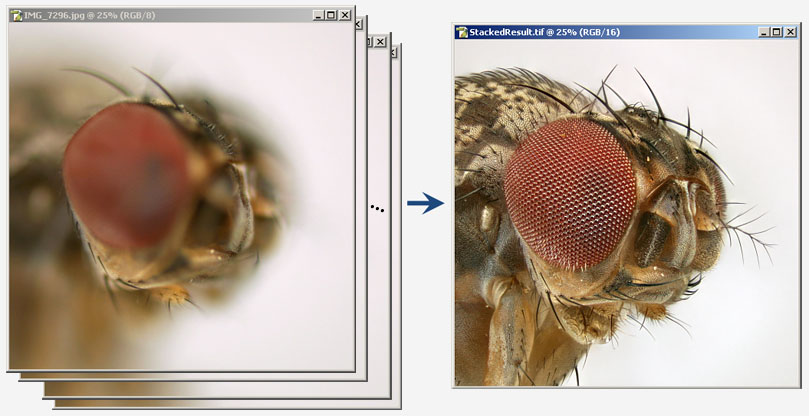
Focus stacking (also known as focal plane merging and z-stacking[1] or focus blending) is a digital image processing technique which combines multiple images taken at different focus distances to give a resulting image with a greater depth of field (DOF) than any of the individual source images.[2][3] Focus stacking can be used in any situation where individual images have a very shallow depth of field; macro photography and optical microscopy are two typical examples. Focus stacking can also be useful in landscape photography.
Focus stacking offers flexibility: since it is a computational technique, images with several different depths of field can be generated in post-processing and compared for best artistic merit or scientific clarity. Focus stacking also allows generation of images physically impossible with normal imaging equipment; images with nonplanar focus regions can be generated. Alternative techniques for generating images with increased or flexible depth of field include wavefront coding and light-field cameras.
Technique[edit]
The starting point for focus stacking is a series of images captured at different focus distances; in each image different areas of the sample will be in focus. While none of these images has the sample entirely in focus they collectively contain all the data required to generate an image which has all parts of the sample in focus. In-focus regions of each image may be detected automatically, for example via edge detection or Fourier analysis, or selected manually. The in-focus patches are then blended together to generate the final image.
Mp560 software high sierra mac update. Technical data is gathered for the products supported by this tool and is used to identify products, provide relevant solutions and automatically update this tool, to improve our products, solutions, services, and your experience as our customer.Note: This tool applies to Microsoft Windows PC's only. This product detection tool installs software on your Microsoft Windows device that allows HP to detect and gather data about your HP and Compaq products to provide quick access to support information and solutions. Examples: 'LaserJet Pro P1102 paper jam', 'EliteBook 840 G3 bios update'Need help finding your product name or product number?
This processing is also called z-stacking, focal plane merging (or zedification in French).[4][5]
In photography[edit]
Getting sufficient depth of field can be particularly challenging in macro photography, because depth of field is smaller (shallower) for objects nearer the camera, so if a small object fills the frame, it is often so close that its entire depth cannot be in focus at once. Depth of field is normally increased by stopping down aperture (using a larger f-number), but beyond a certain point, stopping down causes blurring due to diffraction, which counteracts the benefit of being in focus. It also reduces the luminosity of the image. Focus stacking allows the depth of field of images taken at the sharpest aperture to be effectively increased. The images at right illustrate the increase in DOF that can be achieved by combining multiple exposures.
The Mars Science Laboratory mission has a device called Mars Hand Lens Imager (MAHLI), which can take photos that can later be focus stacked.[6]
In microscopy[edit]
In microscopy high numerical apertures are desirable to capture as much light as possible from a small sample. A high numerical aperture (equivalent to a low f number) gives a very shallow depth of field. Higher magnification objective lenses generally have shallower depth of field; a 100× objective lens with a numerical aperture of around 1.4 has a depth of field of approximately 1 μm. When observing a sample directly the limitations of the shallow depth of field are easy to circumvent by focusing up and down through the sample; to effectively present microscopy data of a complex 3D structure in 2D, focus stacking is a very useful technique.
Atomic resolution scanning transmission electron microscopy encounters similar difficulties, where specimen features are much larger than the depth of field. By taking a through-focal series, the depth of focus can be reconstructed to create a single image entirely in focus.[7]
Software / Application[edit]
| Name | Primary author | Application type | Platform | License |
|---|---|---|---|---|
| Adobe Photoshop[8] CS4, CS5, CS6 | Adobe | Desktop | Windows, Mac OS X | Proprietary |
| Affinity Photo 'Focus Merge' | Serif | Desktop | Windows, Mac OS X | Proprietary |
| Aphelion with Multifocus extension | ADCIS | Desktop | Windows | Proprietary, 30-day trial |
| Amira / Avizo 'Image Stack Projection'[9] | Thermofisher | Desktop | Windows, Mac OS X, Linux | Proprietary |
| CamRanger | CamRanger | Desktop / Mobile | iOS, Android, Mac OS X, Windows | Proprietary |
| Chasys Draw IES | John Paul Chacha | Desktop | Windows | Proprietary |
| CombineZ | Alan Hadley | Desktop | Windows | GPL |
| Enfuse (combined with align_image_stack or similar) | Andrew Mihal and hugin development team | Desktop | Multiplatform | GPL |
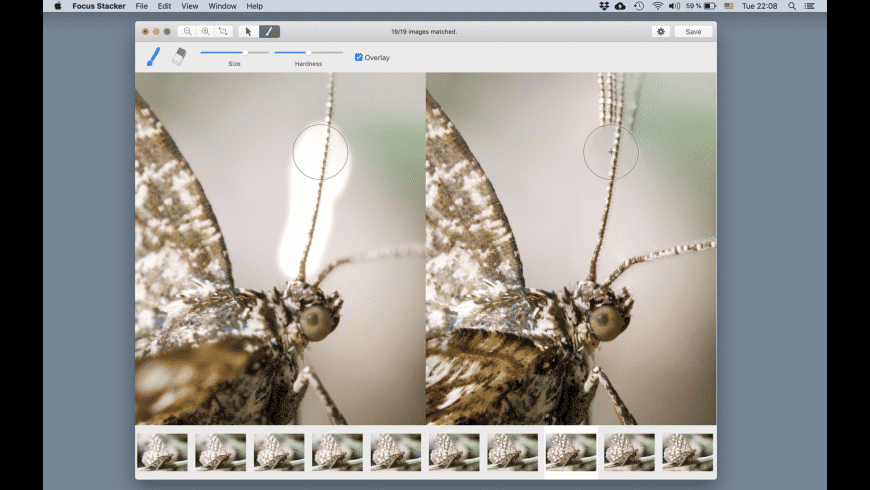
| Focus Stacker | Alexander Boltnev, Olga Kacher | Desktop | Mac OS X | Proprietary |
| Focus Stacking Online[10] | Focus Stacking Online | Web application | All | CC BY-ND 4.0 |
| Shutter Stream Product Photography Software | Iconasys | Desktop | Windows, Mac OS X | Proprietary |
| Helicon Focus | Danylo Kozub | Desktop | Windows, Mac OS X | Proprietary, 30-day trial |
| ImageJ with Extended Depth of Field Plugin | Alex Prudencio, Jesse Berent, Daniel Sage | Desktop | Unix, Linux, Windows, Mac OS 9 and Mac OS X | Public domain |
| MacroFusion[11] | Dariusz Duma | Desktop | Linux | GPL |
| Picolay | Heribert Cypionka | Desktop | Windows | Freeware |
| QuickPHOTO with Deep Focus extension | Promicra | Desktop | Windows | Proprietary, 30-day trial |
| Zerene Stacker | Rik Littlefield | Desktop | Windows, Mac OS X, Linux | Proprietary, 30-day trial |
Gallery[edit]
Pictures[edit]
Pepper mill, stack of 28 frames
Stacked image of 3 × 2.5 mm electric wires
Shaver head, stack of 36 frames, retouched
Macrolepiota procera, stack of 15 frames
Stacked image of the inner ridge of an orchid blossom
Stacked image of two Arecaceae viewed through a hole in a tree trunk
Pellet, stack of 32 frames
Alluaudia comosa, stack of 10 frames
Mold on Litchi chinensis, stack of 20 frames
Skull, stack of 6 frames
Videos[edit]
Diagrams[edit]
Software creates from the sharpest areas in a stack of sections.
See also[edit]
- High dynamic range imaging (HDR)
- Shift-and-add for stacking astrophotos
References[edit]
- ^'Malin Space Science Systems - Mars Science Laboratory (MSL) Mars Hand Lens Imager (MAHLI) Instrument Description'. Msss.com. Retrieved 2012-12-10.
- ^Johnson, Dave (2008). How to Do Everything: Digital Camera (5th ed.). McGraw-Hill Osborne Media. p. 336. ISBN978-0-07-149580-6.
There are a number of programs that allow you to get the equivalent of infinite depth of field in your photos, with sharp focus from the foreground all the way back to the rear. How is this possible? By taking multiple photos of the same scene and stacking them afterwards into a composite that features only the sharpest bits of each image. One of the best is Helicon Focus.
- ^Ray 2002, 231–232
- ^'Afficher le sujet - Proposition d'un terme français pour 'focus stacking' • Le Naturaliste'. Lenaturaliste.net (in French). Retrieved 2012-10-05.
- ^'Malin Space Science Systems - Mars Science Laboratory (MSL) Mars Hand Lens Imager (MAHLI) Instrument Description'. Msss.com. Retrieved 2012-10-05.
- ^'MSL Science Corner: Mars Hand Lens Imager (MAHLI)'. MSL-SciCorner.JPL.NASA.gov. Retrieved 2012-10-05.
- ^Hovden, Robert; Xin, Huolin L.; Muller, David A. (2010). 'Extended Depth of Field for High-Resolution Scanning Transmission Electron Microscopy'. Microscopy and Microanalysis. 17 (1): 75–80. arXiv:1010.4500. Bibcode:2011MiMic.17..75H. doi:10.1017/S1431927610094171. PMID21122192.
- ^'Focus Stacking Made Easy with Photoshop'. photo.tutsplus.com. Retrieved 2013-07-01.
- ^'Avizo User Guide, Module 'Image Stack Projection''. 2018-03-30.
- ^'Focus stacking online - free online focus stacking application'. FocusStackingOnline.com. Retrieved 2020-02-22.
- ^'GUI to Combine Photos to Get Deeper DOF or HDR'. SourceForge.net. Retrieved 2017-10-19.
- Ray, Sidney. 2002. Applied Photographic Optics. 3rd ed. Oxford: Focal Press. ISBN0-240-51540-4.
External links[edit]
- Which cameras have built-in focus stacking?, Nov. 2019.
- Media related to Focus stacking at Wikimedia Commons
Astrophotography is closer to science than art, and there is no such thing as “getting it right in camera.” This means you cannot simply point the camera at the sky and snap away.
In astrophotography you cannot avoid post processing your images, so stacking and editing your images serves three main purposes:
- Reduce noise and deal with light gradients and vignetting.
- Improve signal to noise ratio.
- Reveal the faint details in the image.
Image stacking is the technique used to improve the signal to noise ratio, and it is the only noise reduction method that will boost the image details rather than smear them out.
In this article, we will discuss some of the most popular software available for astrophotography image stacking.
Note: Don’t miss the detailed video at the end of this article, It was created to help show you how to quickly start using some of the stacking software mentioned in this article.
Click here to skip to our Image Stacking Demo Video.
What Does Stacking Photos Mean?
The concept behind image stacking is simple, but to appreciate how it works, there are a couple of things we have to consider:
- A stack can be visualized as a pile of images all stacked one on top of the other;
- Each digital image is formed by a set of pixels, all having a certain value: dark pixels will have a lower value than the bright ones;
In the simplest form of image stacking, the pixels values for all images in the stack are averaged to produce a single image.
What is the purpose of stacking photos?
The result is a single image with improved signal to noise ratio, i.e., with better details and lower (random) digital noise and better details.
The scheme below illustrates the concept.
If the considered digital noise affects the pixel values randomly across the stack, then the result of averaging the stack is that the random component of the noise to the pixel value is significantly reduced.
ISO noise and Luminance noise and Chrominancenoise are examples of digital noises that are random.
The image below shows a real-life example from stacking 30 images from my Sony RX10 bridge camera taken at ISO 6400. As you can see, the original images showed a greater deal of noise (grain) than the stacked one.
The More Images You Stack, The Better
The more images you stack, the cleaner the resulting images are, as shown in the comparison below.
While Image stacking creates a cleaner image, it often softens the image: digital sharpening techniques are then used to recover sharp looking details.
Finally, bear in mind that the progression of image quality is not linear.
If stacking 4 images improves the image quality of 50% respect what you got by stacking only 2 images, to improve a further 50% the image quality from stacking 50 images, you may need to stack 300 images or more.
Image Stacking And Movement
If nothing moves between shots, like in the previous real life example, implementing image stacking is very simple: just group the images and average them to smooth out the noise.
With a moving subject, grouping and averaging the images will not only smooth out the noise, but also the subject itself.
This is the same principle for which long exposures of passing traffic and crowd result in a street image without cars nor people.
This effect is amplified with the number of images used, and the moving subject could simply disappear from the stacked image.
To resolve the issue, you have to align the images based on their content before stacking.
Due to image alignment, you may have to trim the edges of the stacked image to get rid of artifacts, but your target will not be lost.
Note that while in theory you can stack images of a static scene taken with the camera on a tripod, in reality, those images will probably differ at the pixel scale due to micro-movements. It is always beneficial to align the images before stacking.
How To Shoot For Exposure Stacking Your Images
Image stacking can be done with any camera and even camera phones and with images in both RAW and JPEG format.
Mac Photo Stacking Software
Nonetheless, some things can be done to improve the final result:
- Lock the focus, so that the camera will not hunt for it between images. This will also help to keep the focus consistent through the shooting sequence.
- Keep the same settings, in particular shutter speed, aperture, and focal length: you don’t want to change the camera field of view during the sequence, nor the brightness of the images or the depth of field.
- If you are shooting on a tripod, disable image stabilization. If you want to shoot handheld, do so only for short sequences at very high shutter speed.
Image Stacking In Astrophotography
Related:Astrophotography Software & Tools Resource List
As said previously, image stacking is a standard technique implemented in any astrophotography editing workflow for,
- A star field from a fixed tripod.
- A deep sky object from a tracking mount.
- The Moon handheld.
- A starry landscape from a fixed tripod or tracking mount.
Every astronomy image will benefit from image stacking.
List Of Photo Stacking Software For Astrophotography
Here is a list of software used in astrophotography for image stacking.
Adobe Photoshop
Complete Image Editor Commercial – Subscription Plan Photography Bundle $9.99 / Month Mac OS X, Windows
Pro
- Versatile
- Available for Mac and Windows
- In bundle with Adobe Lightroom CC, Bridge, Camera Raw, and web space
- Many action packs and plugins available for astrophotography
Cons
- Subscription Plan only
- Can’t be used to calibrate light frames
- Stacking capabilities are somehow limited
If you are interested in photography, chances are you know Adobe Photoshop is the standard in the industry and does not need introductions.
With Adobe implementing a subscription plan for their applications, if you are using Lightroom CC for your everyday photography, your plan subscription will also include Photoshop CC and Bridge CC.
And for astrophotography, Photoshop is what you need. Lightroom cannot stack your images nor perform the histogram stretching, two crucial steps in the editing workflow for astrophotography.
In this article, we have already covered in detail how to stack astrophotography images with Photoshop.
Sequator
Deep Sky And Starry Landscape Stacker Freeware Windows
Pro
- Free
- Easy to use
- Fast
- Suitable for both Starry Landscapes and Deep Sky images
- Can create Star Trails
Cons
- Windows only
- Limited set of options
- Not suitable for Planetary astrophotography
Sequator is an easy-to-use and intuitive astrophotography software for stacking both starry landscape and deep-sky images. It can also be used to create star trails.
While not as advanced as other stackers, it nonetheless allows you to calibrate your light frames with dark and flat calibration frames. It also allows you to remove light pollution, reduce noise, and perform other simple tasks on the stacked image.
Starry Landscape Stacker
Starry Landscape Stacker Commercial, $39.99 Mac OS X
Pro
- Fast
- Easy to use
Cons
- Mac Os X only
- Does not read RAW files
If you are into starry landscapes and you are a Mac user, Starry Landscape Stacker is a must-have.
Easy to use, it allows you to stack and align the sky and the foreground independently by letting you easily mask the sky.
Unfortunately, the software lacks the support for RAW formats, thus forcing you to convert your RAW images in the more heavy TIFF format.
Aside from that, it works very fast and the final image is of good quality. You can also save the sky only, which is useful to further edit the shot in Photoshop or similar editors.
Starry Sky Stacker
Deep Sky Stacker Commercial, $24.99 Mac OS X
Pro
- Fast
- Easy to use
Cons
- Mac Os X only
- Does not read RAW files
- Basic
Starry Sky Stacker is Starry Landscape Stacker brother and it has been created to stack deep sky astrophotography images.
As Starry Landscape Stacker, Starry Sky Stacker is very easy to use and intuitive, although very basic.
If you are a casual star shooter and a Mac user, this could be a good choice for you.
Deep Sky Stacker
Deep Sky Stacker Freeware Windows
Pro
- Free
- Easy to use
- Fast
- Full light frames calibration
- Features Comet stack modes
- Can Drizzle
- Many advanced stack options and methods available
Cons
- Windows only
- Post-processing is quite limited
- Not suitable for Starry Landscapes nor for Planetary astrophotography
Deep Sky Stacker, better known as DSS, is arguably one of the most widely used software to calibrate and stack astrophotography images.
With DSS, you can fully calibrate your images with Darks, Flats, Dark Flats, and Bias calibration frames for the best results possible. Light frames are analyzed and scored by quality so that you can decide which percentage of best images you can stack (Best 75% by default).
A very interesting feature is that with DSS, you can easily combine images taken during different imaging sessions, to produce images of higher quality.
Autostakkert!
Planetary Stacker Freeware Windows
Pro
- Free
- Easy to use
- Suitable for Planetary, Lunar and Solar images
- Stack full planetary disk and lunar surface close-ups
Cons
- Interface a bit confused
- It does not offer wavelet sharpening
- Windows only
Autostakkert!, also known as AS!, is a very popular free software among the solar system astrophotographers. With AS! it is easy to stack both images showing the full Planetary (or Lunar or Solar) disc and images showing lunar surface close-ups.
The interface is a bit confusing, particularly in the beginning, but it is easy to navigate through the different steps for the stacking.
Unfortunately, AS! does not offer wavelet sharpening, which is a widely used technique in planetary and lunar astrophotography. For this, you can load your stacked image in Registax, another freeware software for Windows only that, sadly, is now “abandoned-ware.”
Lynkeos
Planetary Stacker Freeware Mac OS X
Pro
- Free
- Has deconvolution and wavelet sharpening
- It is probably the only freeware planetary stacker for Mac OS X
Photo Focus Stacking Software Mac Review
Cons
- Not very intuitive
- Somewhat slower than Autostakkert!
Lynkeos is perhaps the only freeware planetary stacker software for Mac OS X, sparing you from turning to Windows for using Autostakkert!.
The interface is quite intuitive to navigate, but not when it comes to performing the different tasks.
On the other hand, it offers a deconvolution method and wavelet sharpening, a must-have for a planetary stacker. Definitely worth having a look at it if you are a Mac user.
SiriL
Deep Sky Astrophotography Editor Freeware Mac OS X, Windows, Linux
Pro
- Free
- Cross-Platform
- Active development
Cons
- A bit convoluted and not as intuitive as other stackers
SiriL is a freeware, cross-platform, astrophotography package that will let you calibrate, stack, and develop deep sky astrophotography images.
While not as easy and intuitive as Sequator or DSS, it offers a lot of options and produces good results. There is an active community, and it is under constant development.
Astro Pixel Processor
Deep Sky Astrophotography Editor Commercial $60/Yr Renter License Or $150 Owner License Mac OS X, Windows, Linux
Pro
- Full-grown astrophotography package
- Fairly easy to use
- Mosaics are created with ease and are of great quality
- Active and constant development
- Cross-Platform
- 30-days Trial period
- Affordable yearly subscription
Cons
- Only for deep sky astrophotography
- No Comet stacking mode
With Astro Pixel Processor (APP), you step in the realm of full-grown astrophotography packages, with many advanced options and methods to calibrate, stack, and post-process your deep-sky images.
Compared to PixInsight (PI), the software benchmark for the category, APP is cheaper and way easier to use, which makes it one of the best PI alternatives.
If you decide to buy it, you can choose between the renter’s license for $60/yr, to always get the latest version of APP, or the owner’s license for $150, but you will have to purchase the license again for major update releases.
PixInsight
Astrophotography Editor Commercial – €230+VAT Mac OS X, Windows, Linux
Pro
- It has all you need for astrophotography
- 45 days trial period
- A lot of tutorials and information available
Cons
- Expensive and without subscription plan
- Extremely steep learning curve
- Long and convoluted process
- Needs a powerful computer
When it comes to astrophotography, PixInsight is the software of reference against which all others are measured. It offers everything you may possibly need to produce pro graded images, and it is objectively the best software in the field.
But user experience can be frustrating, as the learning curve is very steep, the editing is long and convoluted, and your computer must be quite recent and powerful to make it run smoothly.
The €230 + VAT price tag is also quite steep: sure it is worth every penny, but this makes PI be even more the software of choice for professional and keen amateur astrophotographers.
Photo Focus Stacking Software Mac Download
A Comprehensive Demo About Image Stacking
In this video, I show you how easy it is to wet our feet with image stacking.
This is particularly true if you use Starry Landscape Stacker, Sequator, Deep Sky Stacker and Autostakkert!, as I showed in the video below.
Conclusion
Image stacking is one of the crucial steps in the astrophotography editing workflow.
Astro Photo Stacking Software Mac
You’ll need the appropriate stacker for each type of astrophotography: starry landscapes, star trails, or deep-sky and planetary images.
In this article, we have covered the most popular astrophotography stackers available on the market, both freeware and commercial.
And while Windows users have the more extensive choice, some notable stackers are available for Mac and even Linux users.